

In the arid, red heart of Australia, a river defies the very laws of geography. While most rivers eventually dry up or change their course over millions of years, the Finke River has followed the same path for nearly 400 million years. Known as Larapinta to the Indigenous Arrernte people, this ancient waterway is widely recognized as the oldest river system in the world. It began carving its way through the landscape long before the first dinosaur ever walked the Earth.
Geological time
Scientists estimate that the Finke River originated during the Devonian or Carboniferous periods (roughly 300 to 400 million years ago). To put that in perspective, the Atlantic Ocean didn’t even exist yet, and the world’s continents were still huddled together in the supercontinent Gondwana.
What makes the Finke truly unique is a geological phenomenon called antecedence. Most rivers flow around mountains or follow the path of least resistance. However, the Finke River was already flowing before the MacDonnell Ranges even existed. As tectonic forces slowly pushed the mountains upward during the Alice Springs Orogeny, the river didn’t change its path. Instead, it “sawed” through the rising rock, maintaining its original course. This is why you see the river cutting directly through hard quartzite mountain ranges today.
The river of sands and shadows
Unlike the mighty Amazon or the Nile, the Finke River does not flow year-round. For most of the year, it exists as a “ghost river” a vast, sandy bed dotted with permanent waterholes.
- Intermittent Flow: The river only “comes alive” after heavy tropical rains in the north. When it does, it transforms into a powerful, rushing torrent.
- The Simpson Desert Sink: Most of the time, the water disappears into the thirsty sands of the Simpson Desert. Only during rare, massive floods does the water travel its full 640 to 750 kilometers to reach the terminal basin of Lake Eyre.
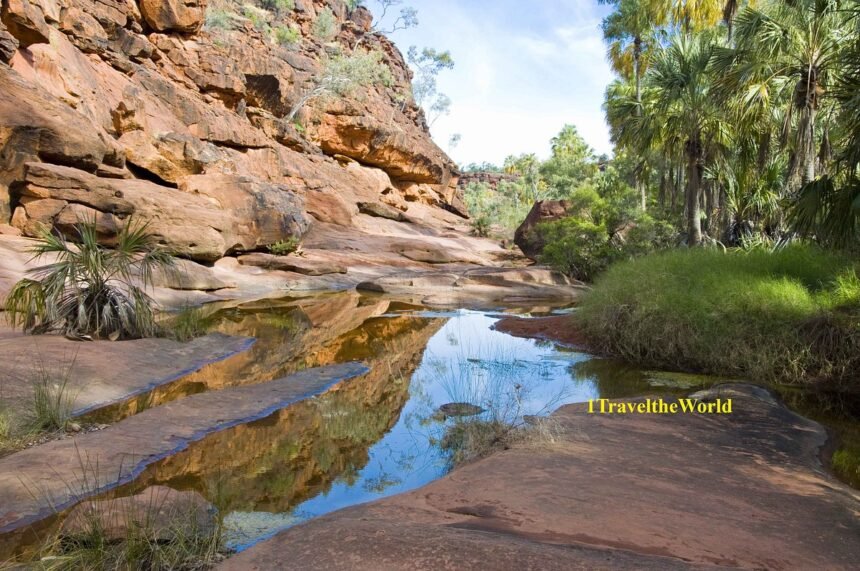
- A Living Oasis: Even when the surface is dry, water remains trapped in deep underground reservoirs and permanent pools like those in Palm Valley. These waterholes sustain unique plants and animals that have survived here for millions of years.
Significance
For the Arrernte people, Larapinta is more than just a geographical feature; it is a sacred part of their “Dreaming” stories. Local legends tell of a gigantic serpent that traveled north from Lake Eyre, carving the river’s winding path into the earth. For tens of thousands of years, these ancient waterholes have served as vital survival camps for Indigenous communities in the desert.
Ecologically, the Finke is a refuge for “relict” species. In places like Finke Gorge National Park, you can find the Red Cabbage Palm. These palms are leftovers from a time when Central Australia was a lush, tropical rainforest. As the continent dried out over millions of years, these plants survived only in the shaded, moist pockets created by the ancient river’s gorges.
Hrithik Roshan’s Stunt Fails Moments While Shooting Action Scenes