


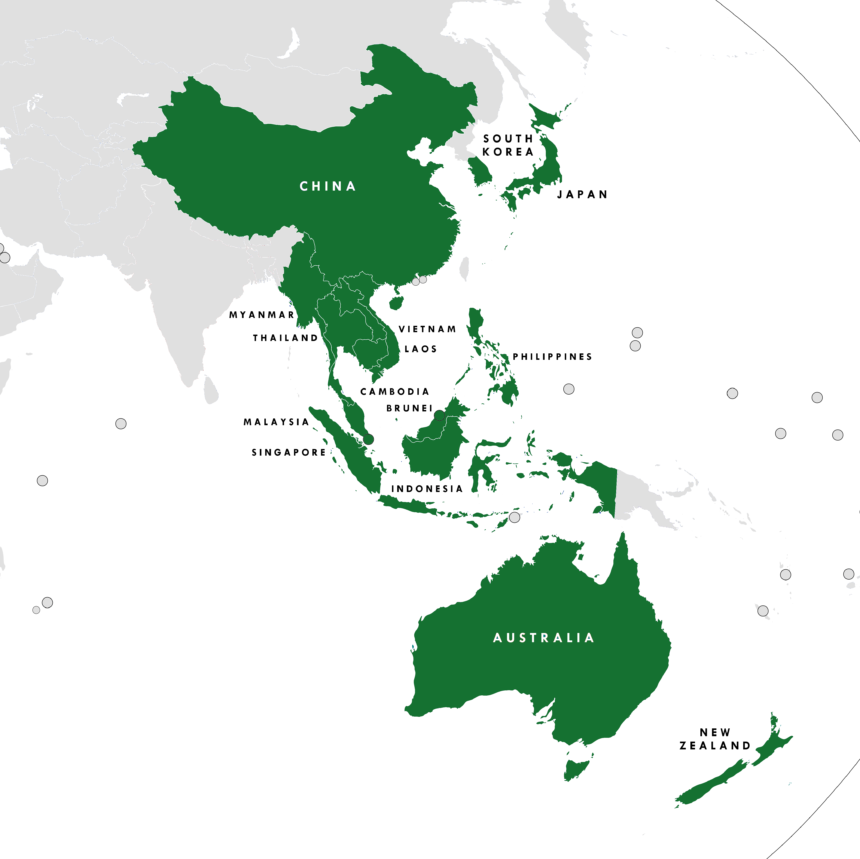
More than six years after India opted out of RCEP (2019), India has secured most of the economic benefits of RCEP without formally joining it. The India-New Zealand FTA is a milestone. India now has FTAs with all RCEP members except China. Therefore, this reflects a carefully calibrated trade strategy balancing market access, strategic autonomy, economic and national security.Fast forward to today, India has successfully executed an “RCEP Minus China” strategy. In simple words, this means India has managed to sign individual trade deals with almost every member of the RCEP bloc while keeping China out of the loop.
Background
In 2019, India made a historic decision to walk away from the Regional Comprehensive Economic Partnership (RCEP), the world’s largest trade bloc. The reason was simple: the deal included China, and India feared its markets would be flooded with cheap Chinese goods, destroying local manufacturing.
The Core Strategy: “One-on-One” instead of “All-in-One”
The RCEP is a massive group of 15 countries (ASEAN nations plus China, Japan, South Korea, Australia, and New Zealand). India’s strategy was to avoid the “package deal” where China was the dominant player.
Instead, India chose a bilateral path. By signing separate Free Trade Agreements (FTAs) with individual members, India gets the same “VIP access” to those markets without having to lower its guard against China.
2. The Final Piece of the Puzzle: New Zealand
For years, the “RCEP Minus China” goal was nearly complete, but not quite. India already had deals with ASEAN, Japan, and South Korea. In 2022, it signed a major deal with Australia (ECTA).
The final gap was New Zealand. In late 2025, India concluded negotiations for an FTA with New Zealand. With this deal, India effectively has trade agreements with 14 out of the 15 RCEP members. The only one left out? China.
Why this is a win for India?
By choosing this path, India achieved three major goals that the original RCEP deal would have compromised:
- Protection from Dumping: In a group deal like RCEP, it is hard to stop Chinese goods from “sneaking in” through other countries. By signing bilateral deals, India has Strict Rules of Origin. This means a product must be genuinely made in Australia or New Zealand to get a tax break, preventing China from using them as a “backdoor.”
- Safeguarding Farmers: India was terrified that RCEP would allow cheap dairy from New Zealand to ruin Indian dairy farmers. In the bilateral deal, India was able to keep its “red lines,” protecting sensitive sectors like dairy and agriculture while opening up other areas like IT and education.
- Strategic Autonomy: India maintains the power to hike taxes (tariffs) if it sees an import surge from China. If India were in RCEP, its hands would be tied by the group’s collective rules.
Integration
Critics once said that by leaving RCEP, India would be “isolated” from Asian supply chains. However, the “RCEP Minus China” strategy proves otherwise. India is now more integrated with the Asia-Pacific than ever before it just did so on its own terms.
India is part of the Indo-Pacific Economic Framework (IPEF) and has deep trade ties with all major regional players. It has secured the economic benefits of the region (market access and investment) while avoiding the “China Risk” (trade deficits and industrial hollowing).
Investigative Group Set to Release Exposé on Indian Corporations