


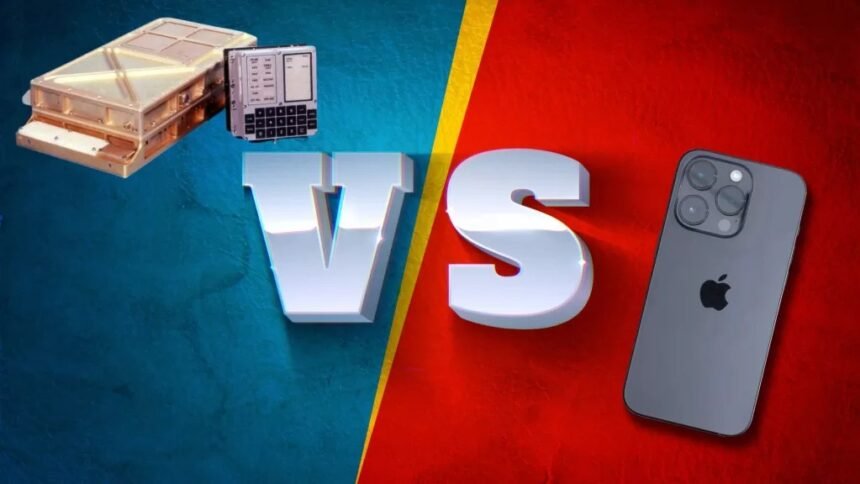
In 1969, the world watched in awe as Apollo 11 carried astronauts to the Moon and safely brought them back to Earth. This historic mission represented the peak of human technological achievement at the time. Surprisingly, the smartphone you carry in your pocket today is far more powerful than the computer that guided Apollo 11 to the Moon. While it sounds unbelievable, the comparison highlights just how far technology has come in just a few decades.
Can NATO Survive a Crisis From Within? The Trump–Greenland Challenge Explained
The Computer That Took Humans to the Moon
Apollo 11 relied on the Apollo Guidance Computer (AGC), one of the first computers designed for space travel. It had extremely limited capabilities by today’s standards. The AGC operated with a clock speed of about 1 MHz, had roughly 64 KB of memory, and could perform only a limited number of calculations per second.
Despite these limitations, the AGC was revolutionary for its time. It guided navigation, controlled spacecraft orientation, and helped astronauts land on the Moon with remarkable precision. The success of Apollo 11 proves that innovation and smart engineering matter just as much as raw computing power.
The Power Inside Your Smartphone
Modern smartphones contain processors that operate at billions of cycles per second, often exceeding 3 GHz. They have gigabytes of RAM, advanced graphics processing units, and dedicated AI chips. This allows them to handle complex tasks like real-time navigation, facial recognition, 4K video recording, and artificial intelligence all simultaneously.
In simple terms, your smartphone can process millions of times more data than the Apollo 11 computer ever could. What once required a room-sized computer now fits in the palm of your hand.
Beyond Speed: Sensors and Connectivity
Apollo 11 had no internet, GPS, or high-resolution cameras. Today’s smartphones include motion sensors, accelerometers, gyroscopes, biometric scanners, and satellite-based navigation systems. They can instantly access vast amounts of information from anywhere in the world.
This level of connectivity and versatility makes smartphones not just powerful computers, but complete digital ecosystems.
Why This Comparison Matters
The comparison between Apollo 11 and smartphones isn’t meant to diminish the Moon mission. Instead, it highlights the incredible pace of technological progress. The engineers of the 1960s achieved the impossible with limited resources, laying the foundation for modern computing.
Their work paved the way for the devices we now take for granted.