


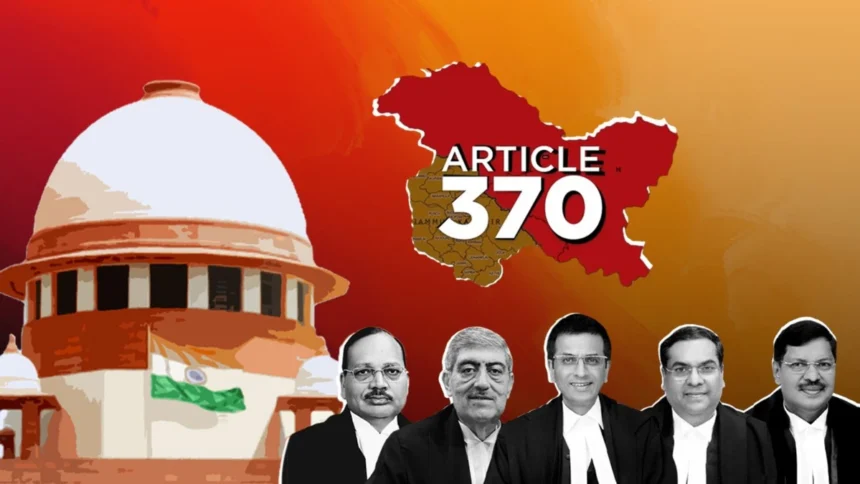
The Supreme Court ordered the restoration of statehood in Jammu and Kashmir while simultaneously upholding the central government’s reorganization of Ladakh as a Union Territory. The ruling, accompanied by a concurring judgment from Supreme Court Justice Sanjay Kishan Kaul, emphasized the temporary nature of Article 370, adding another layer to the complex socio-political landscape of the region.
Justice Kaul’s assertion that Article 370 was meant to be temporary provides legal context to the government’s moves in the region. This constitutional perspective, integral to the court’s decision, has far-reaching implications and underscores the evolving nature of governance in Jammu and Kashmir.
Former Chief Minister of Jammu and Kashmir, Ghulam Nabi Azad, expressed disappointment in the Supreme Court’s verdict, describing it as ‘sad and unfortunate.’ Azad’s sentiment reflects the dissatisfaction among some sections of the population, highlighting the challenges of reconciling legal decisions with public expectations.
The restoration of statehood in Jammu and Kashmir signifies a significant step towards normalizing the region’s political status. However, the concurrent affirmation of Ladakh as a Union Territory underscores the intricate balance between regional autonomy and central governance.
The divergent opinions on the Supreme Court’s ruling underscore the longstanding complexities of the Jammu and Kashmir issue. While legal experts may commend the court’s interpretation of Article 370, the ground-level sentiments, as expressed by Ghulam Nabi Azad, suggest a gap between legal reasoning and public expectations.
It is crucial to acknowledge that decisions impacting the political status of a region with a history as nuanced as Jammu and Kashmir’s are bound to evoke diverse reactions. The delicate balance between preserving constitutional integrity and addressing the aspirations of the local population adds layers of complexity to such judgments.
More About Supreme Court’s Decision:
The assertion that the people of Jammu and Kashmir may not be entirely happy with the verdict, yet have to accept it, underscores the challenging task of reconciling legal imperatives with the socio-political aspirations of a diverse populace. This acceptance, though tinged with discontent, may pave the way for a recalibration of regional dynamics and aspirations.
As the dust settles on the Supreme Court’s decision, the focus will likely shift towards the practical implications of restoring statehood in Jammu and Kashmir. Striking a delicate balance between regional autonomy and national integration remains a persistent challenge—one that will shape the future trajectory of the region.
The Supreme Court’s verdict on Jammu and Kashmir is a multifaceted tapestry of legal intricacies and public sentiments. It provides a legal framework for the region’s political landscape while also acknowledging the diverse feelings of the people involved. The road ahead requires a nuanced approach that respects both constitutional principles and the aspirations of the local population.


